
History
The breadfruit tree, whose scientific name is Artocarpus altilis, belongs to the Moraceae family and is believed to originate from the region of New Guinea. The earliest research places it there around 3,500 years ago.
It was discovered by the Polynesians, who planted it everywhere they travelled across the Pacific. Indonesians later introduced it to insular and coastal Southeast Asia, and it eventually spread widely throughout the tropics during the colonial period.
During an attempt to transport breadfruit trees to the West Indies, the crew of the famous HMAV Bounty is said to have been executed on April 28, 1789. As a result, it was only a year later, in 1790, that breadfruit arrived in Martinique.
The purpose of introducing breadfruit to Martinique was to provide food for enslaved people, but its success was not immediate. They preferred bananas.
Varieties
There are many varieties of breadfruit, differing by region and shape.
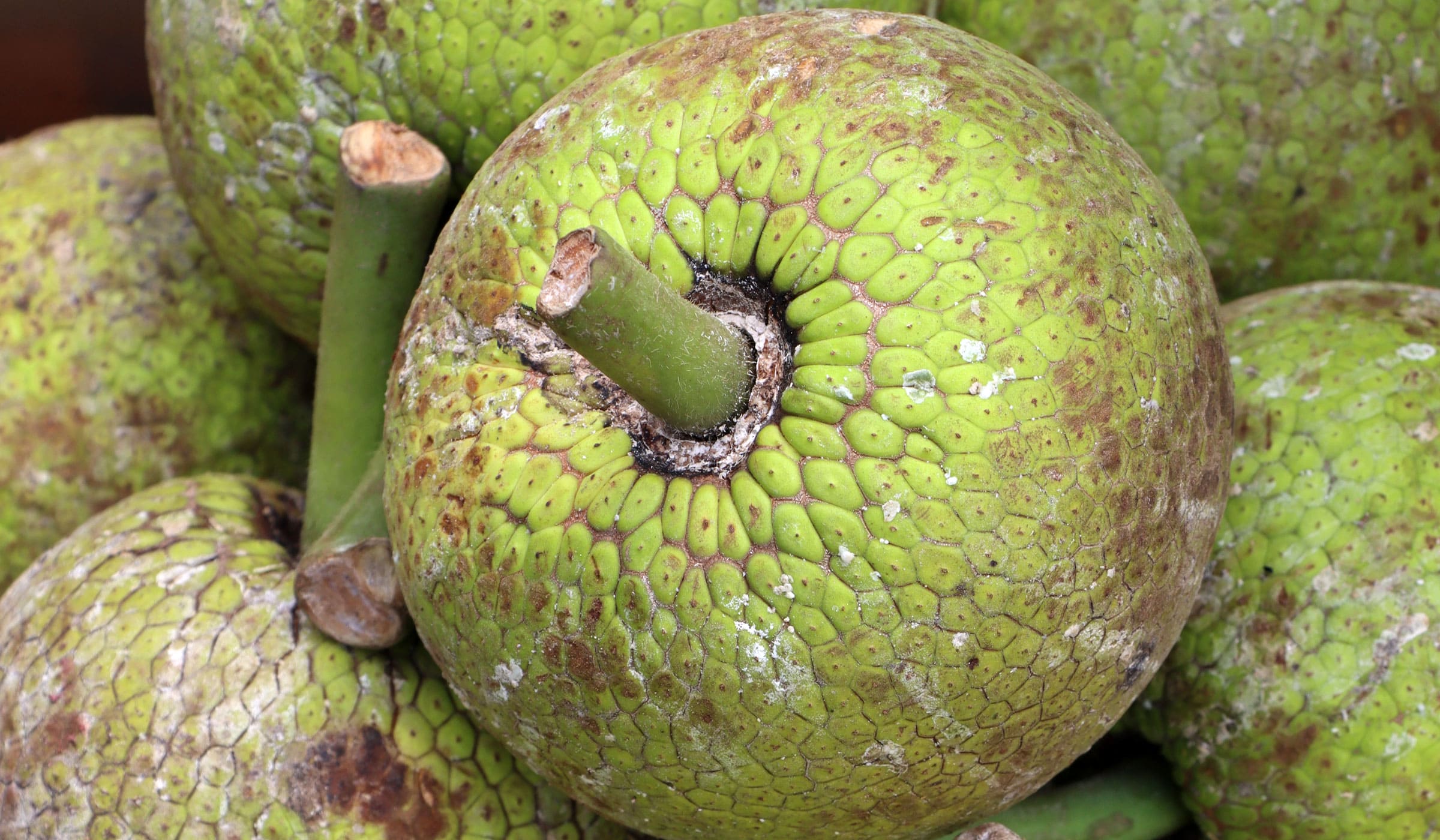
While in the South Pacific, a single tree can produce nearly 150 fruits per year, in the Caribbean, each tree produces only about 25 fruits annually. The ovoid fruit has a rough surface, and each fruit is divided into several achenes, each surrounded by a fleshy perianth and increasingly by a fleshy receptacle.
Most selectively bred cultivars produce seedless fruits. In Martinique, they are generally found from October to February.
Medicinal properties
Breadfruit is a highly energetic food. Its starch and sugar content make it rich in calories. It also contains a high level of carbohydrates (starches), which turn into sugar as the fruit ripens.
Medicinally, breadfruit is not widely used, but it does possess a few therapeutic properties. It can help combat liver disorders and hypertension.
Uses
Breadfruit is part of what is known as “légumes pays” (local root vegetables and staples). It is a starchy food, similar to rice, pasta, or other local staples such as dasheen, green bananas, and yams. Rich in starch, it is eaten as a main side dish alongside meat or fish. It is most often consumed after being cooked in salted water.
After removing the thick skin, the core must be taken out, and the white flesh cut into thick pieces. Like potatoes, breadfruit can be prepared as a gratin or migan after boiling.
It can also be cut into pieces and fried to make delicious fries or croquettes. These dishes are usually savory, but breadfruit can also be used in sweet preparations such as flan or cake. In any case, breadfruit has become fully integrated into local cuisine and can often be found in restaurants across the island.


